In recent weeks, a controversial Immigration and Customs Enforcement (ICE) enforcement operation near Minneapolis has ignited a fierce national debate over immigration policy.
The treatment of children during enforcement actions, and the role of federal authorities in local communities. At the center of this uproar is the revelation that ICE has detained at least four children from the same school district in the Minneapolis suburb of Columbia Heights.
Including a five‑year‑old boy named Liam Conejo Ramos, whose detention sparked particularly intense backlash. Vice President JD Vance, the second‑in‑command in the Biden administration, has publicly addressed the situation, defending the federal response and urging local officials to cooperate with enforcement efforts.
His remarks have added fuel to an already heated national conversation about immigration, law enforcement authority, and the rights of families and children.

The ICE Operation in Minneapolis: Background & Controversy
Over the past several weeks, federal immigration agents have intensified enforcement activity in the Minneapolis–Saint Paul area, focusing on individuals suspected of being in the United States without lawful status.
This effort follows escalating tensions in the city after a federal agent shot and killed a local resident, Renee Good, on January 7 during clashes between ICE officers and community members. The shooting itself sparked local investigations and protests.
Against this backdrop, reports began circulating that ICE officers had detained multiple individuals — including children as they observed them near schools, homes, or coming home from classes.
Columbia Heights Public Schools Superintendent Zena Stenvik has publicly stated that federal agents have been present “around our neighborhoods, circling our schools, following our buses, coming into our parking lots and taking our kids,” leaving families and educators “shaken” and students traumatized.
According to Stenvik and multiple school officials, the children detained were not threats to public safety, and at least one family — that of the five‑year‑old — was participating in lawful immigration processes at the time.
The Case of Five‑Year‑Old Liam Conejo Ramos
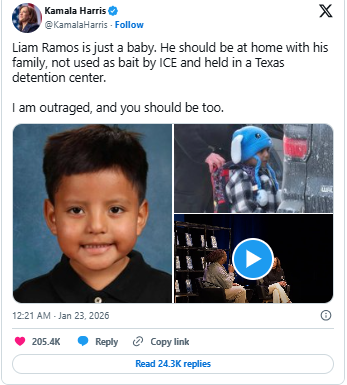
The most widely reported incident involved five‑year‑old Liam Conejo Ramos, who was detained along with his father, Adrian Alexander Conejo Arias, shortly after the boy arrived home from preschool on January 20.
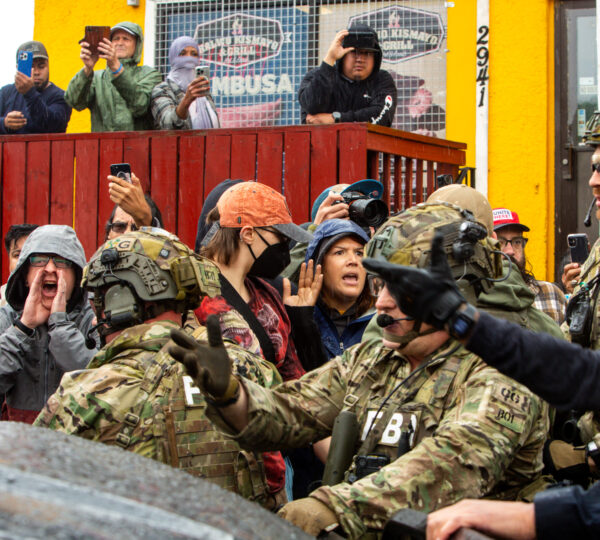
Some local witnesses and district leaders stated that agents used the young boy to knock on the family’s door as part of their enforcement procedure — a claim that drew intense criticism from parents, educators, and lawmakers nationwide.
Liam and his father — who were reportedly lawfully seeking asylum and had no deportation order — were placed at a family detention facility in Texas, more than 1,000 miles from their Minnesota home.
This event rapidly became a symbolic flashpoint in the immigration debate, prompting responses from Democratic lawmakers, civil rights advocates, educators, and the media.
Department of Homeland Security’s Account
Federal officials, including spokespeople for the Department of Homeland Security (DHS) and ICE, disputed several elements of the narrative offered by local school officials. In their version of events:
The father was the target of the enforcement action because he was in the United States illegally.
When agents approached, the father fled, leaving the child in or near a vehicle.
Officers remained with the child for his safety and later took the boy into custody alongside his father.
DHS said agents attempted to reunify the child with relatives or caregivers, but the boy remained with his family.
DHS officials have explicitly denied that the child was ever a target of enforcement or that agents engaged in inappropriate conduct. They emphasize that children are not, as a matter of policy, the focus of ICE enforcement actions.
Still, survivors, families, and school officials dispute the account, saying there were adults present who could have cared for the boy, and that ICE refused to allow this.
ICE Detentions Beyond Liam
Liam’s case is not isolated. School district leaders in Columbia Heights confirmed that at least four students were taken into ICE custody in recent weeks, including a 10‑year‑old elementary student, and two 17‑year‑old students — one apprehended on the way to school and another at a residence.
These detentions have left families and educators deeply concerned. Parents have spoken about the emotional trauma suffered by children, some of whom are too young to fully grasp what is happening to them or why federal agents would take them from their homes or neighborhoods.
Community Impact and Reactions
Across Columbia Heights and beyond, the presence of heavily armed federal agents near schools and residential areas has created a climate of fear and uncertainty.
Teachers report students expressing worry about whether they — or their parents — could be taken, disrupting attendance and learning.
Zena Stenvik, the school superintendent, described one particularly harrowing moment when the detained child’s mother, present near the family home, was visibly distraught and confused about why her family was being treated as criminals despite following immigration procedures and having asylum paperwork.
The legal counsel for Liam’s family has also refuted claims that they were evading ICE, saying they were in the United States legally and actively participating in asylum proceedings.
Vice President JD Vance Weighs In
In response to the growing public outcry, Vice President JD Vance traveled to Minneapolis to defend the federal approach.
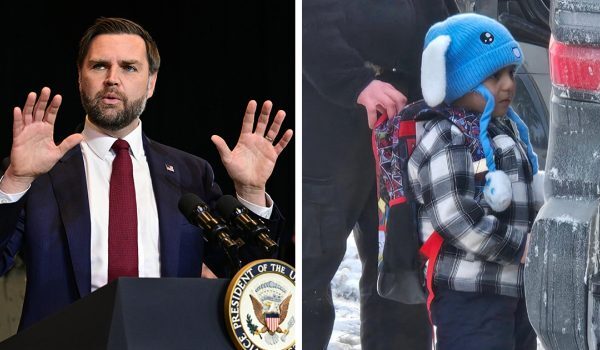
During his remarks, Vance placed responsibility for the unrest in the city on local officials and non‑cooperation with federal authorities, rather than on the actions of ICE agents themselves.
He suggested that officials in the city were being advised not to assist federal law enforcement, which he claimed contributed to a chaotic environment that other jurisdictions — he pointed to cities such as Los Angeles and Chicago — did not experience to the same degree.
When addressing the specific case of the detained five‑year‑old, Vance acknowledged the emotional reaction many parents would have upon seeing the photos but emphasized his interpretation of the facts as presented by ICE and DHS.
He explained that, in his view, the child was not formally arrested, but instead was taken into custody for his safety after his father fled federal agents.
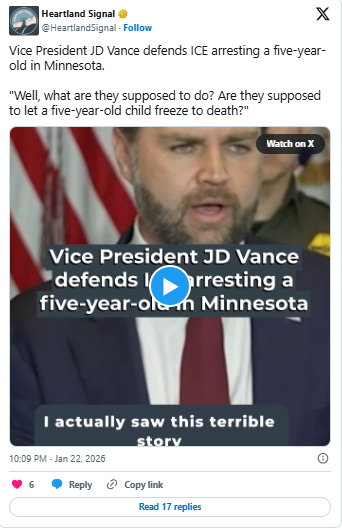
As an example of his point, Vance said: “What are they supposed to do? Are they supposed to let a five‑year‑old child freeze to death? Are they not supposed to arrest an illegal alien in the United States of America?”
His statements underscored his belief that enforcing immigration law is paramount, even if emotionally difficult for observers, and that law enforcement should not exempt individuals from arrest simply because they have young children.
Political Dimensions of the Debate
Vance’s comments reflect broader tensions within U.S. politics over immigration enforcement, child welfare, and federal versus local authority.
Democrats and immigration advocates have condemned the detentions as inhumane and destructive, particularly in light of the reportedly lawful status of some families and the trauma inflicted on young children.
Republicans and administration officials, including Vance, argue that the United States must uphold its immigration laws and that enforcement must be consistent to maintain the rule of law. They contend that local resistance to cooperation with federal authorities undermines safety and contributes to disorder.
This debate comes at a time when the administration has deployed roughly 3,000 federal agents to the Minneapolis area and has faced protests and clashes — not only over detentions but also around public safety and federal presence in city neighborhoods.
Law Enforcement and School Safety
The impact on schools has been particularly controversial. Columbia Heights Public Schools superintendent Stenvik and other local leaders have said they want schools to be safe spaces where students feel secure every day, and ICE’s presence near school grounds has disrupted that sense of safety.
It has been reported that ICE vehicles have even entered school property, although school administrators have asked them to leave.
This has further heightened tensions between federal authorities and local education officials who are worried about the emotional toll on students, many of whom have family members in mixed‑status situations.
Humanitarian Concerns and Broader Implications
Child detentions in immigration enforcement raise complex legal and ethical questions. Under U.S. policy, children are not intentionally targeted for enforcement, but they may be taken into custody when accompanying parents or family members.
The boundary between protecting a child’s safety and inadvertently causing emotional trauma remains a subject of national debate.
Advocates argue that enforcement practices must account for the welfare of minors and seek alternatives that prevent traumatizing children who have done nothing illegal themselves. Critics of the operations in Minnesota also note that separation from schools and communities can have long‑term psychological effects.
Legal Status and Asylum Claims
In multiple reports, legal representatives for families detained in these actions have stressed that many of those arrested, including the father of Liam, were in the United States legally and were actively pursuing asylum.
Asylum claims are a lawful pathway for individuals fleeing persecution or extreme danger abroad. Advocates stress that detaining families engaged in this process undermines trust in the system and could discourage vulnerable individuals from seeking protection through legal means.
Looking Ahead: Policy, Accountability, and Public Debate
As the situation continues, lawmakers from both parties are debating the appropriate balance between strict immigration enforcement and humane treatment of families and children.
Many Republicans have supported Vance’s stance on law enforcement and cooperation, while many Democrats and civil liberties groups have called for oversight, policy reform, and increased accountability for how federal agencies conduct operations involving families.
The outrage over these detentions, especially among educators and parents, has sparked calls for congressional inquiries and greater transparency in how immigration enforcement actions are planned and executed.
Meanwhile, local pressure in Minneapolis and Columbia Heights continues, with community members organizing protests, petition drives, and legal challenges to federal tactics that they say undermine civil liberties and jeopardize public trust.
Conclusion: A Nation in Debate
The controversy over ICE’s actions in Minnesota — and Vice President JD Vance’s defense of those actions — underscores a deeply polarized moment in American politics.
It highlights the difficult crossroads between enforcing immigration laws and protecting vulnerable populations, including children.
Whether one views Vance’s remarks as a necessary defense of legal principles or a dismissal of humanitarian concerns, the discourse around these events has re‑energized national discussion about immigration policy, family rights, enforcement transparency, and the responsibilities of local and federal authorities.
As lawmakers, educators, civil rights advocates, and community members continue to grapple with these issues, the fate of the families involved — including young children like Liam — remains central to the broader debate about how the United States balances law, compassion, and justice in the modern era.