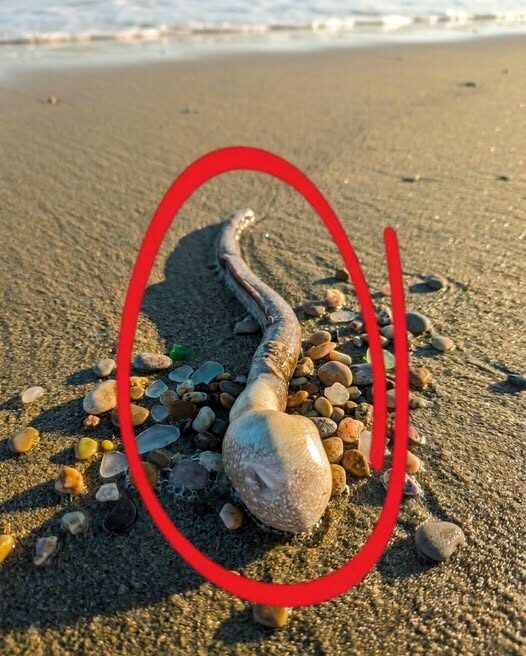
Imagine walking along the beach with your dog and suddenly discovering a strange creature washed ashore. Its long, snake-like body and unusually swollen head could easily make you wonder whether you had stumbled upon something rarely seen before. Such discoveries often attract attention because the remains can look dramatically different from familiar marine animals.
One possible explanation for this unusual appearance is a dead eel. Eels have long, slender bodies that can resemble snakes, making them difficult to identify, especially when their remains have deteriorated. Without clear features such as recognizable fins, a defined head, or other identifying characteristics, even an ordinary marine animal can appear mysterious.
Decomposition can significantly change an animal’s appearance after death. As tissues break down, gases may accumulate and cause parts of the body to swell. Exposure to seawater, waves, sand, and scavenging organisms can also damage the remains or remove recognizable features. These changes may create unusual proportions, making a familiar animal look almost unrecognizable.
Although the ocean is home to many fascinating creatures, a strange-looking carcass is not necessarily evidence of an unknown species. Scientists generally need clear photographs, identifiable anatomical features, or direct examination to determine what an animal is. In this case, the available description suggests an eel as a possibility, but it does not establish the species or confirm what caused the swelling.
If you encounter unusual animal remains on a beach, observe them from a safe distance rather than touching or moving them. Keep children and pets away, and consider notifying local wildlife or marine authorities if the animal appears unusual or particularly large. Sometimes, what looks like a mysterious sea creature has a much more ordinary explanation. Even so, these discoveries remind us how dramatically natural processes can transform the appearance of marine life.